Adaptive advertising? You mean DCO. Not quite.
October 31, 2026
Share this article



Every time I bring up adaptive advertising in a client meeting in Brussels, I get the same reaction. A polite nod, a little smile, and then "Ah yes, DCO. We already do that."
I understand why. For years, "adaptive" has meant one thing in our industry, a banner that swaps its picture, its price or its language depending on who sees it. It works, and it has its place. But it's only the very last step of a campaign.
So I usually answer with a question. If the creative adapts but the plan behind it stays exactly the same, what have you really adapted?
Belgium is a small country on a map and a complex one on a media plan. Three languages, three regions, and daily realities that shift every few dozen kilometres. A national campaign here is never quite national. It's a collection of territories that don't live at the same pace.
Take school holidays. This very month, French-speaking families get two weeks of autumn break, while Flemish families get one, and not exactly at the same time. Now picture a toy retailer or a family travel brand running one plan for the whole country. With DCO, the ad will be in French in Namur and in Dutch in Ghent. Perfect. Yet the budget will still go out in the same weeks everywhere, which means reaching half of the country's parents either too early or too late. Translating the message doesn't fix the timing.
Or take the way we get around. In Antwerp, plenty of everyday errands happen by bike. In Liège, between the hills and the distances, the car is still king. A car maintenance brand promoting its winter tyre check doesn't have the same potential in both cities, and shouldn't invest in them the same way. No creative variation will ever tell you that. Only the plan can.

This is where adaptive advertising stops being a creative option and becomes a category of its own. It starts long before the ad is designed. It means finding the right audience in each territory, understanding the context a brand should show up in, choosing the message that will actually resonate, and deciding how much to invest where, region by region and sometimes town by town. Then it carries all of that through to activation, in the same place, so nothing gets lost between the strategy and what goes live.
DCO adapts an ad. Adaptive advertising adapts the whole campaign.
For a long time, this simply wasn't realistic. Building a plan truly adapted to each Belgian territory meant days of work and spreadsheets everywhere, so most teams settled for one national plan with a few translated versions. Technology has changed that. What used to sit in strategy decks as a nice ambition can now actually run, and that's the conviction we've built our approach on at Locala.
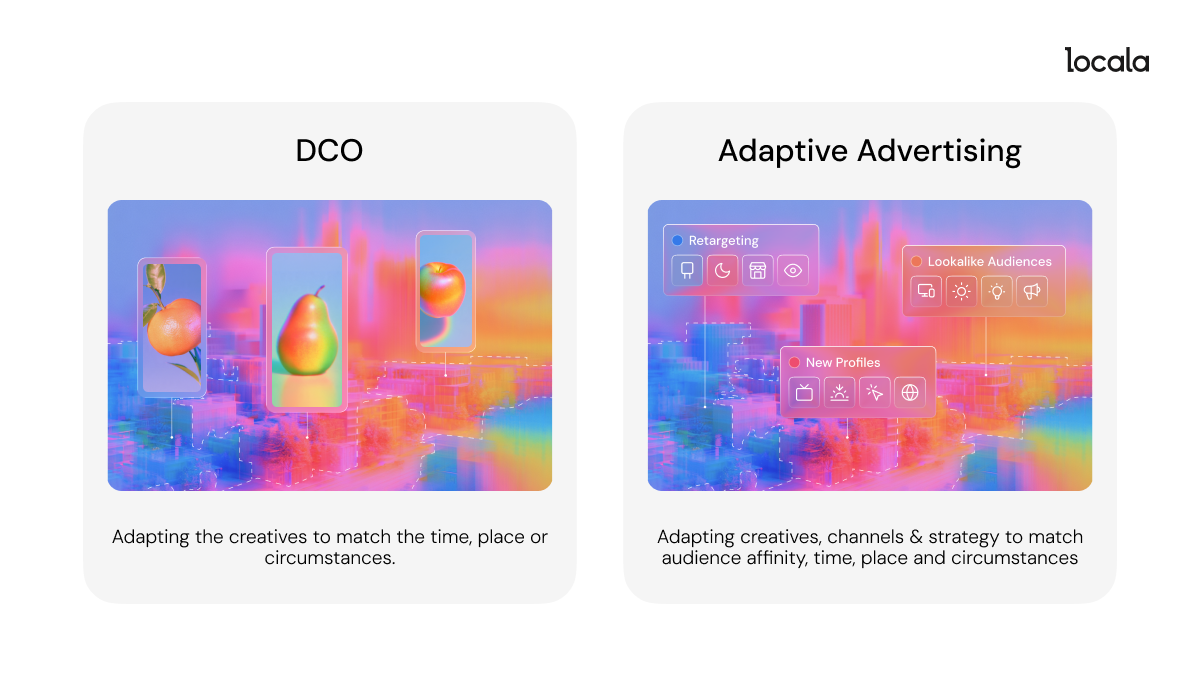
Next time someone tells me adaptive advertising already exists, I'll agree with them. Part of it does, the creative part. The rest, the part that decides who, where, when and how much, is what makes a campaign genuinely adapted to the people it's meant for. And in a country like ours, that's where most of the value is hiding. It's exactly why, at Locala, we chose to launch adaptive advertising as a new category in its own right.
Here's a little test for your next national campaign. Look at what really sets your audiences in Liège and Antwerp apart, the way they get around, shop, plan their holidays. If it goes far beyond the language and your plan still treats them the same, you're not running one campaign. You're repeating the same mistake in three regions. Let's talk.