

Your dashboard is green. Coverage is strong. Performance appears steady. And yet, beneath the surface, you may be losing ground where it matters most.
This is the paradox of national averages. An 80% national reach can coexist with a 20% drop in market share in your most critical cities. A stable national traffic trend can mask declining performance in your key stores. A campaign that looks successful at scale can underperform exactly where growth is needed most.
The green dashboard is seductive because it is reassuring but it can hide issues. It compresses asymmetries into a single number, replacing granularity with aggregation. We call it consistency. But it is not a reflection of reality.
The limits of national averages
Marketing mix models are powerful. They set budgets, measure channel contribution, and connect investment to outcomes. But they are built on averages. They flatten the geographic variation that actually defines consumer behavior. They tell you how much to invest nationally, not where that investment will truly matter.
The result? We end up optimizing for blended metrics that reflect no real market. We miss where competitive pressure is intensifying, where awareness is fragile, where store proximity limits growth.
National strategies rarely fail because they are wrong. They fail because they are never translated into local reality.
From insight to action
At Locala, we’ve taken a different path, building national strategies that consider local realities.
With OmniPlanner, we’ve bridged online and offline signals for the first time, giving teams a continuously updated view of local brand dynamics and business context. Some catchments are fortresses of loyalty. Others are competitive battlefields where precision and intensity are everything. Treating them the same way is not a strategy, it’s a growth failure.
But understanding asymmetry is only half the challenge. The real question is: can you act on it, consistently and at scale?
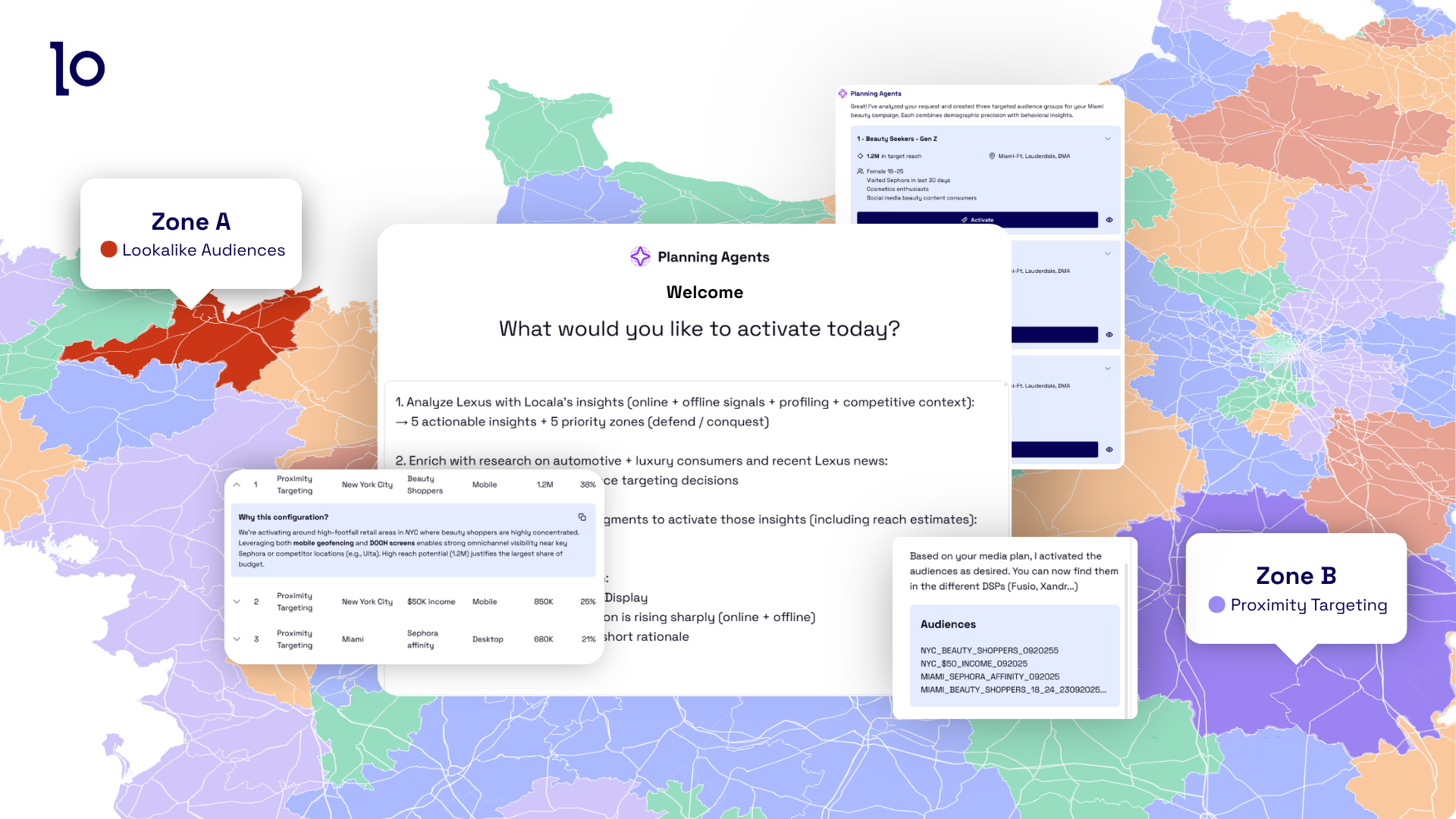
This is where planning agents come in. Built as an extension of OmniPlanner, they translate intelligence into concrete decisions: where to prioritize, how to allocate budget, which audiences to activate in each market.
No gap between strategy and execution. No loss of granularity.
The real question
Growth doesn’t only happen at the national level. It mainly happens city by city, catchment by catchment.
National averages provide comfort. Local insight provides clarity. But clarity alone is no longer enough. The challenge is turning it into action, everywhere it matters.
If you’re rethinking how to translate national strategy into localized growth, the question is no longer just what your dashboard shows. It’s whether you can act on what it hides.
Book a demo to learn more.