

AI to work faster, or AI to work better ?
Everyone in the market probably sees at least three announcements a day about “agentic” features in adtech right now. The word is doing a suspicious amount of unpaid labor for products that are still hard to see, hard to test, or hard to trust.
For the past few years, our industry has talked about AI mostly through the lens of productivity: faster copy, faster reporting, faster campaign setup. While useful, that is not transformative.
What is happening in 2026 feels fundamentally different. The conversation is shifting from “AI that helps people work faster” to autonomous AI agents that can interpret a business objective, interact across systems, and orchestrate complex workflows under human definition.
The future of advertising will not be decided by who builds the best chatbot. The real question is: what can your agents actually orchestrate?
3 categories are emerging
When you look past the buzzwords, the market shift is being driven by three clear structural waves, and they are converging faster than most people realize.
The first is about interoperability. AI agents cannot operate in isolation. Standards like the Ad Context Protocol (AdCP) and the IAB Tech Lab’s AAMP initiative are establishing a shared language across the ecosystem. Without this layer, every new agent simply becomes a faster silo, and a faster silo is still a silo.
The second wave is platforms turning agentic. Core tech players are moving from manual configurations to outcome-based control. DSPs and SSPs are embedding specialized agents to handle everything from inventory curation to real-time bid optimization. The human role is shifting from operator to outcome architect.
The third is agencies becoming platforms themselves. Major global networks are rolling out custom orchestration layers that finally integrate production, strategy, and media buying into a single workflow.
Together, these three shifts are attacking the deepest structural problem in modern media: the gap between strategy decks and activation platforms. That gap has survived every previous wave of adtech innovation. This one might actually close it.
Beyond the demo: The 5 non-negotiables of agentic AI
Real media planning runs on messy briefs, fragmented data, and fluid consumer behavior. Moving from a controlled environment to real-world execution means addressing five challenges the industry can no longer ignore.
The first is prompt routing and privacy. Media plans contain highly sensitive budgets, target regions, and client priorities. Serious agentic AI requires ring-fenced data environments where brand data is strictly isolated and never used to train public foundation models. This is non-negotiable.
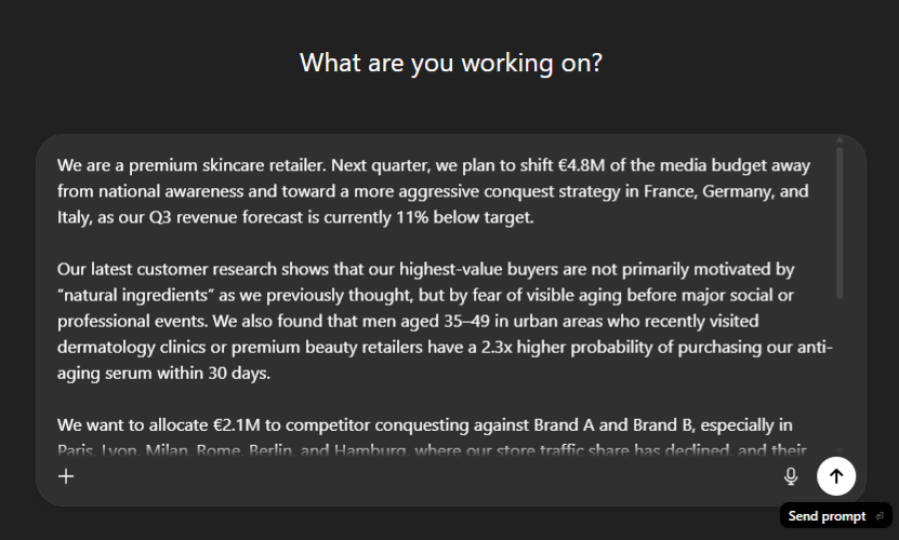
Would you press “send”?
The second is explainability. Confident answers are not the same as trustworthy answers. If an agent shifts budget from display to CTV in a specific city, a media planner must be able to audit why. Black boxes are a liability, not a feature.
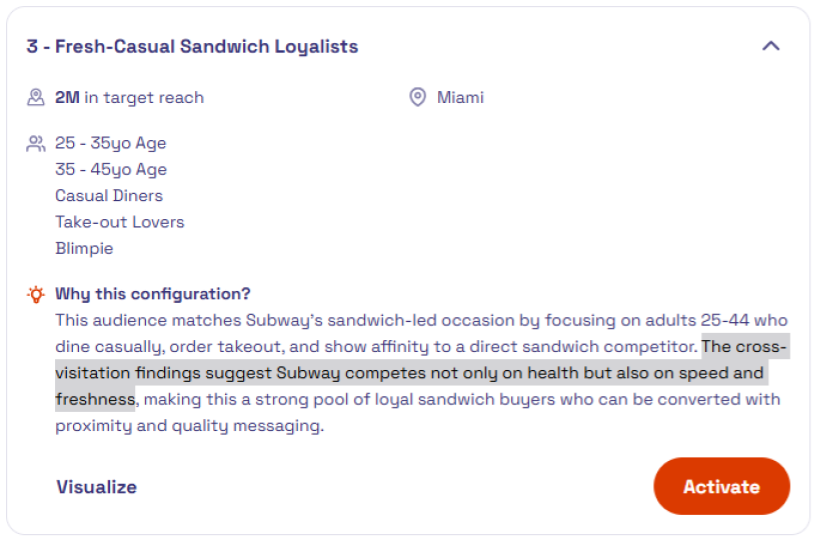
Example of audiences created by Locala’s Planning Agents
The third is the closed silo threat. If every platform isolates its agent inside a walled garden, fragmentation simply gets a cleaner interface. True ecosystem value depends on agent-to-platform handshakes that pass context seamlessly, not just within one vendor’s stack.
The fourth is the language gap between technology and operations. To scale agentic systems, media organizations need dedicated pods where AI engineers and media planners work together. The “brain” which is context, strategy, reasoning must operate in lockstep with the “arms” which is DSPs, connectivity, platform specifications. One without the other produces either clever tools nobody uses or fast execution with no judgment.
The fifth, and most important, is the ambition gap. If an agent only automates a task, the ambition is too small. The real opportunity is not doing the same average campaigns faster. It is making hyper-local, multi-channel strategies executable at a level of granularity that was previously impossible for any human team to manage.
Raising the strategic ceiling: moving from “assist” to “act”
A controlled demo is the weakest way to judge an AI product. In the real world, media planning runs on messy briefs, fragmented data, and fluid consumer behavior.
At Locala, we believe serious agentic infrastructure must treat the audience as a response to local business context, not as a shortcuts-based starting point. Before deciding who to target, an agent must safely evaluate where a brand needs to grow and why performance fluctuates store-by-store or city-by-city.
The mandate for the industry is clear: Agents are here to lower our operational floor by stripping out repetitive drudgery, while simultaneously raising our strategic ceiling.
Autonomy should live inside permissions, audit trails, and strict human guide. Let’s leave the buzzwords behind and build infrastructure that actually moves real business metrics. Let’s talk about it!